
Why The Media Needs Objectivity
My new book, The Trust Spiral, is out now in the UK

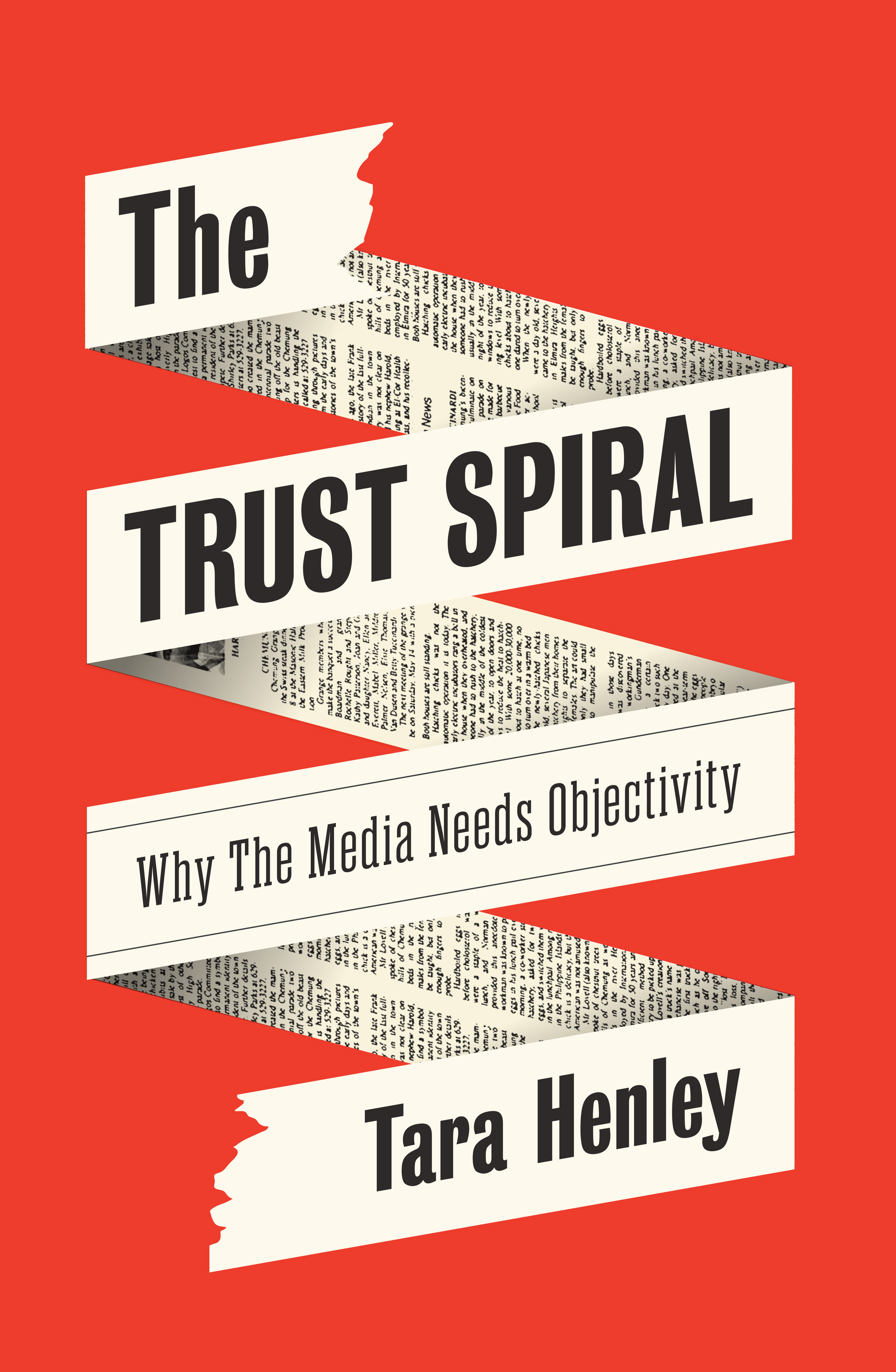
Hi all, I’m pleased to announce that my new book, The Trust Spiral, is now out in the UK. My publisher Polity invited me to write a blog for their website on the themes of the book and I’m happy to share that post with you today.
The Trust Spiral will be out in the U.S. and Canada on July 28, and pre-orders help tremendously. If you feel moved to do so, you can pre-order the book here. — TH
In Canada, as in other Western democracies, trust in the media is low. According to the Reuters Institute for the Study of Journalism, 39 percent of Canadians trust the media overall — down almost 20 percentage points from 2018. Not surprisingly, there’s been a public conversation about this crisis in confidence, with national press leadership attributing it to everything from attention fragmentation and news avoidance to bad actors online and rhetorical attacks from hostile politicians. While all of these factors may indeed be contributing, such explanations lack self-reflection. To regain trust, we in the media must ask: What’s our role in this?
As it turns out, a recent prize-winning essay demonstrates exactly where we’ve gone wrong. Friends of Canadian Media is a non-partisan advocacy group. It runs an annual essay contest with a $10,000 prize — and this year’s winner was instructive.
Shauna Rae’s Beyond Objectivity: How Creator Journalism Helps Democracy Remember Its Voice explores a long-simmering internecine battle over objectivity that boiled over in 2020, with one side promoting a move toward advocacy journalism and the other seeking to preserve a more traditional, dispassionate approach to the news.
The Beyond Objectivity essay opens with what Rae frames as a problem: collective anxiety over “creator journalism.” While that term goes undefined, one assumes that she’s referring to the rise of non-institutional, activist-oriented online channels and outlets and influencers, many of whom do not feel beholden to the standards and practices that govern newsrooms. Rae argues that pushback to this development “rests on a fragile assumption: that journalism has always been neutral, institutional and detached from moral position.” She continues: “The idea that neutrality is journalism’s natural or necessary state is not a historical truth but a relatively recent inheritance.”
A former radio journalist, Rae rejects the method of objectivity passed down to her from previous generations, including her newspaper reporter father and her radio news director grandfather, and indeed the industry as a whole. At the journalism school she trained at, she writes, “neutrality was framed as both a shield and a compass: Remove yourself from the story, suppress personal response, quote opposing sides, and let ‘the facts’ speak for themselves.” She adds: “Objectivity was never presented as a theory or a debate but as a discipline, something to be mastered, enforced and defended at all times.”
This line of argument originated with a vocal contingent of Stateside journalists, including Wesley Lowery, who famously tweeted in June of 2020 that “American view-from-nowhere, ‘objectivity’-obsessed, both-sides journalism is a failed experiment … We need to rebuild our industry as one that operates from a place of moral clarity.” Writing in The New York Times that same month, Lowery asserted: “No journalistic process is objective. And no individual journalist is objective, because no human being is.” Rae similarly maintains that every editorial decision, from story and source selection to language choice, reflects personal bias. Younger audiences recognize this as a crisis in credibility, she argues, and “see through the veil.” (Bizarrely, she even characterizes objectivity as a mental health hazard, in that it leaves no space for reporters to process the trauma they witness, and also teaches them to restrain their empathy in order to remain neutral.)
Objectivity, according to Rae, emerged during World War I as an economic strategy for wire services — “a practical answer to the demands of scale, speed and national cohesion.” She points to an earlier tradition, when “Canadian media voices were openly activist.” Reclaiming that tradition, she believes, is the path forward for our embattled industry.
Rae presents her position as a countercultural one, but in reality it may be closer to the industry’s status quo. For a 2023 research project, the celebrated former Washington Post editor Leonard Downie Jr., now a journalism professor, wrote in The Washington Post that “increasingly, reporters, editors and media critics argue that the concept of journalistic objectivity is a distortion of reality.” Along with fellow professor and former CBS News president Andrew Heyward, Downie interviewed more than 75 reporters, newsroom leaders, and media experts about values and practices, and found what appears to be “the beginning of another generational shift in American journalism.”
The purpose of my new book The Trust Spiral is to explore how this rejection of objectivity became widespread — and to demonstrate why it’s counterproductive for the goal of restoring public trust in the media.
Returning to Rae’s essay, it’s important to note that she makes a common mistake. Objectivity did not originate as a commercial strategy but as a cultural strategy. The newspapers of the 19th Century were openly partisan, often financed by political parties. Then came the penny papers, which, according to Columbia University scholar Michael Schudson’s landmark book Discovering the News, forged a more “democratic attitude toward the happenings of the world,” taking their revenue from advertising and subscriptions, and covering a broader range of topics. “Most of the penny papers,” Schudson wrote, “including all of the pioneers in the field, claimed political independence, something that earlier papers rarely pretended to.” The New York Times “established the standard,” famously proclaiming in 1896 that it aimed to “give the news impartially, without fear or favour.” This new objectivity was also responding to what Schudson described as the “skepticism and suspicion which thinkers of the late nineteenth century, like Nietzsche, taught.” Then came the early 20th Century and the rise of public relations and propaganda as tools to sculpt public opinion. In the wake of grave reporting errors during World War I, there was mounting cynicism in the population. Objectivity was not a negation of reporters’ inherent subjectivity, but rather a recognition of it — a way of attempting to mitigate against the inherently subjective nature of our work. Adopting the period’s fascination with empiricism and the scientific method, objectivity evolved into a set of standards and practices for producing news that was as reliable and replicable as possible.
An entire body of scholarship rests on this understanding of objectivity. A good primer can be found in a Liberties journal essay, The War on Objectivity in American Journalism, by Rutgers historian David Greenberg. In that essay, Greenberg defines objectivity as “the unceasing attempt to correct subjectivity and thereby come closer to what people of many standpoints can agree is the truth.” He describes its specific policies and practices thus:
In the reporting stage, they call for independently verifying sources’ claims and talking to a mix of sources so as not to fall captive to one person’s perspective. In the writing stage, they prescribe an antiseptic tone: no ideology, snark, self-righteousness, anger, euphoria, invective, or exaggeration. They call for furnishing evidence to substantiate doubtful assertions. They stipulate the attribution of claims to let readers judge their validity. They require the inclusion of multiple, competing explanations about complex or controversial issues. Similar practices exist for editing (having multiple editors review a story); photojournalism (no staging or doctoring images); even anchoring the news (the Olympian Cronkite delivery). Large news agencies concerned with protecting their reputation for objectivity also impose rules to reassure readers that their employees approach stories with an open mind. While correspondents may offer considered judgements about the events they cover, they must not have conflicts of interest — a scruple that is a small moral revolution in itself. And they may not crusade on behalf of a cause or spout off carelessly. Doing otherwise would compromise their credibility …
Like many others who reject objectivity, Rae does not bother clarifying which of these policies and practices she’d like to see eliminated. Does she think that news-gathering journalists should not be required to furnish evidence to substantiate claims? Does she believe the press should feel free to doctor images? Decline disclosing conflicts of interest? Not provide attribution? Surely not.
Instead of getting specific, though, she puts forward a highly vague formulation: “journalists for justice.” This approach, she writes, would follow in the footsteps of Canadian activist-journalists, who “refused impartiality in the face of injustice.”
As far as I can tell, this basically amounts to the “moral clarity” model from Wesley Lowery — an idea that has not stood up well under criticism, including from David Greenberg. He wrote in Liberties that “determining the correct moral posture on a political or policy issue is almost always difficult and certainly beyond the capacity of a daily journalist working at digital speed.” Leading with moral convictions before determining the facts, Greenberg told me on my podcast, can be problematic: “Because we’re always going to be wrong, no matter how virtuous or politic. Even if we believe that our own world view is fundamentally sound, sometimes the other side has a point.” Such concerns were echoed by Atlantic staff writer George Packer. “Moral clarity has a way of blinding us to the nuances and the details that make it harder to make up your mind,” he told me. “But that’s what readers have to confront: that things are difficult, that most issues are hard to make up your mind about.”
Respected news leaders such as the legendary Post editor Marty Baron, New York Times editor Joe Kahn, and New York Times publisher A.G. Sulzberger have all mounted defences of the objectivity model. But in Canada, we are still stuck in 2020, with such arguments failing to penetrate the anti-objectivity consensus.
It’s important to understand that activist journalists’ rejection of objectivity has occurred against a backdrop of plummeting revenues, collapsing business models, widespread outlet closures and layoffs, and a catastrophic decline in institutional resources, capacity, and training.
North American media was already profoundly weakened when Donald Trump arrived on the scene, with his norm-busting behaviour and his provocations that the news media was “fake news” and an “enemy of the people.” Starting in 2016, many mainstream American pundits came to view him as an existential threat, setting off a panic. “If you’re a working journalist and you believe that Donald J. Trump is a demagogue playing to the nation’s worst racist and nationalistic tendencies, that he cozies up to anti-American dictators and that he would be dangerous with control of the United States nuclear codes, how the heck are you supposed to cover him?” Rutenberg wrote in The New York Times. “Because if you believe all of those things, you have to throw out the textbook American journalism has been using for the better part of the past half-century, if not longer, and approach it in a way you’ve never approached anything in your career.” Influential media thinkers like Jay Rosen and Margaret Sullivan agreed, arguing that exceptional times called for exceptional measures.
The problem is that guardrails exist for a reason. And predictably, the erosion of standards and practices did not end up being limited to Trump. New emergencies continually arrived, from Russian interference in American politics, to #MeToo, the racial reckoning, and the pandemic. What began with allowing inflammatory language to creep into news coverage about Trump (see: the debate over the word “lie”) quickly progressed to adopting more lax practices generally, including not calling the subjects of hit pieces for comment, not publishing corrections on reporting errors (favouring stealth edits instead), and not feeling obliged to quote all sides of contentious societal debates (such as on pandemic policy and paediatric gender medicine).
It’s worth dwelling, for a moment, on the particular brand of politics that anti-objectivity activists would like to see advanced. Returning to Rae, she identifies herself online as “a white, cis-gender, heterosexual woman of privilege” — thus signalling her allegiance to progressive politics. But what she fails to understand is that the progressive politics she’s espousing are in fact the politics of wealthy, white, university-educated urban knowledge workers. In other words: the elites.
This connection has been explored at length in two critically-acclaimed books, We Have Never Been Woke from journalism professor Musa al-Gharbi, and Outclassed from law professor Joan C. Williams. Both stress that as popular as progressive politics are in the laptop class, this worldview represents a relatively small slice of the public. In the U.S., Pew Research estimates it at 6 percent. And the Canadian scholar Eric Kaufmann, who is based in the UK, reports similar findings for Canada. In a recent report, The Politics of the Culture Wars in Canada, he found that on issue after issue, the majority of Canadians rejected the views of progressive activists.
If we can acknowledge that progressive views are not widely shared, we should ask ourselves this: What is democratic about a press reorienting itself around advancing the views of a slim minority?
It must also be stressed that abandoning objectivity has been shown to produce a lot of factual errors. The aims of activism and the aims of truth-seeking journalism are not always compatible, and in our era of an increasingly activist press corps we’ve gotten a lot of stories wrong, from the Russian interference story to the lab leak theory of the origin of the pandemic and pandemic school closures. (And, in Canada, the “mass graves” story that’s currently roiling the nation. More on this next week.)
The crux of it all is that we in the media have neglected our fundamental role, which is to inform the citizenry so that it can decide how it wants to be governed. That, of course, is what democracy is all about.
The public, for its part, has not forgotten this. According to the Reuters Institute for the Study of Journalism, the majority of the global public — some 74 percent — prefer news that provides a wide range of views and allows audiences to make up their own minds. In the somewhere between hundreds and thousands of messages I’ve received from the public, I have repeatedly heard this view expressed. People would like us to deliver the facts, to the best of our ability, and leave the public to sort out the rest.
A media ecosphere in which polarized, politically-motivated outlets compete to shape narratives — and members of the public have no idea what is true and what is not — is a disaster for democracy. We in the press should stop rejecting objectivity, and stop rewarding those who do with lucrative prizes.
For more on objectivity, check out this recent episode of Full Press, a media criticism podcast at The Hub with my co-hosts Harrison Lowman and Peter Menzies. Our latest episode is on journalistic mistakes around the mass graves story. For more on that story, here’s my interview with Chief Aaron Pete from 2025.
Congratulations on your new book Tara! My thought on reading the Shauna Rae essay commentary was 'if you can't get on board with objectivity, what about curiousity? How do you get into journalism as a profession, and not be curious about what the world and the humans in it have to offer, that you don't already know or believe?' Anyhow I put that in the category of Monday-morning head-shakers, and did something more productive, which is pre-order your book and share the news with some friends :)
Preordered from Wiley.